Aromatic
Woody
Notesangelica rootbelladonnahemlocklicoricepatchoulirosemarywhite lichenwormwood
Tags
#fresh
#smoky
#sweet
Style
unisex
“In rifleing the closet of the ladie, they found a pipe of oyntement, wherewith she greased a staffe, upon which she ambled and galloped through thick and thin, when and in what manner she listed”
– Proceedings Against Dame Alice Kyteler, Prosecuted for Sorcery, 1324
Hexensalbe, also known as witches’ flying ointment, was a hallucinogenic salve used in witchcraft in the middle ages. It was a mixture of extremely poisonous ingredients that produced an ecstatic trance with powerful sensations of flying, images of otherworldly creatures and a primal sexual hunger.
But where did the witches’ broomstick come in? The ointment was too poisonous to eat, so instead it was applied to other soft membranes, commonly the genitals. Because of the erotic effects of the high, the salve would often be rubbed directly onto a phallic object like the end of a staff or a broomstick. (Now that’s what we call “riding a broomstick”!)
Given which aspects of the history of hexensalbe have been suppressed, it would seem that the one thing more terrifying than witches is female sexuality. This fragrance celebrates the forbidden rituals of personal power, summoning the ancient ways with dark aromatics: wormwood, liquorice, belladonna and black hemlock. Voluptuous tuberose and vibrant patchouli ensure a long and blissful trip.
All about this fragrance
Vibe check
This is a scent for close, deliberate spaces where its herbal bite and smoky sweetness can unfold without noise. It suits someone who likes their presence a little uncanny and self-possessed, with a dry, magnetic trail that feels more intimate than loud.
How to wear
Best in cool weather or evening air, Hexensalbe wears well with a light hand: one to two sprays are enough to let the aromatic herbs, licorice and woody smoke stay clear. On skin it reads darker and more resinous; in the air it keeps a low, atmospheric profile rather than projecting broadly.
Who it’s for
For wearers drawn to herbal, unconventional compositions with a gothic edge, especially those who enjoy licorice, wormwood, smoky woods and strange green bitterness. It will appeal to people who prefer character and texture over polish, and who like fragrances that feel conceptual but still wearable.
Release year
2023
The nose
Stora Skuggan develops Hexensalbe collectively, without a named perfumer, through in-house experimentation in its Stockholm lab. The result fits the house’s broader approach: concept-led, tightly edited compositions where narrative and structure are built together rather than handed off to a single nose.
Collaborators
The fragrance was shaped by Stora Skuggan’s founders working as a shared creative unit, developing the formula in-house rather than assigning it to an outside perfumer. Their role was both conceptual and technical: they built the scent around the medieval flying-ointment myth and refined it through the brand’s own Stockholm laboratory process.
Stora Skuggan’s story
Stora Skuggan is a Stockholm house known for myth-driven, unisex perfumes that sit between folklore, natural phenomena and speculative storytelling. Its identity combines Scandinavian restraint with a taste for the uncanny, using careful construction, small-batch production and a strong visual world to make each scent feel like a self-contained universe.
Hexensalbe’s concept
Hexensalbe takes its cue from the medieval legend of witches’ flying ointment, a poisonous salve associated with ecstatic trances, visions and forbidden sexuality. The fragrance translates that story into an herbal, darkly sensual composition, drawing on wormwood, licorice, belladonna, hemlock and patchouli to evoke the idea of an ancient ritual rather than a literal reconstruction.
Extra info
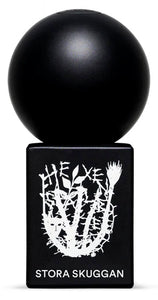
Hexensalbe means “witches’ salve” in German and refers to the legendary flying ointment of European witch lore. The scent’s note structure mirrors that folklore with poisonous herbs and dark aromatics, while the brand’s minimalist bottle design reinforces its eerie, storybook atmosphere.
Notesangelica rootbelladonnahemlocklicoricepatchoulirosemarywhite lichenwormwood
Tags
#fresh
#smoky
#sweet
Style
unisex
“In rifleing the closet of the ladie, they found a pipe of oyntement, wherewith she greased a staffe, upon which she ambled and galloped through thick and thin, when and in what manner she listed”
– Proceedings Against Dame Alice Kyteler, Prosecuted for Sorcery, 1324
Hexensalbe, also known as witches’ flying ointment, was a hallucinogenic salve used in witchcraft in the middle ages. It was a mixture of extremely poisonous ingredients that produced an ecstatic trance with powerful sensations of flying, images of otherworldly creatures and a primal sexual hunger.
But where did the witches’ broomstick come in? The ointment was too poisonous to eat, so instead it was applied to other soft membranes, commonly the genitals. Because of the erotic effects of the high, the salve would often be rubbed directly onto a phallic object like the end of a staff or a broomstick. (Now that’s what we call “riding a broomstick”!)
Given which aspects of the history of hexensalbe have been suppressed, it would seem that the one thing more terrifying than witches is female sexuality. This fragrance celebrates the forbidden rituals of personal power, summoning the ancient ways with dark aromatics: wormwood, liquorice, belladonna and black hemlock. Voluptuous tuberose and vibrant patchouli ensure a long and blissful trip.
All about this fragrance
Vibe check
This is a scent for close, deliberate spaces where its herbal bite and smoky sweetness can unfold without noise. It suits someone who likes their presence a little uncanny and self-possessed, with a dry, magnetic trail that feels more intimate than loud.
How to wear
Best in cool weather or evening air, Hexensalbe wears well with a light hand: one to two sprays are enough to let the aromatic herbs, licorice and woody smoke stay clear. On skin it reads darker and more resinous; in the air it keeps a low, atmospheric profile rather than projecting broadly.
Who it’s for
For wearers drawn to herbal, unconventional compositions with a gothic edge, especially those who enjoy licorice, wormwood, smoky woods and strange green bitterness. It will appeal to people who prefer character and texture over polish, and who like fragrances that feel conceptual but still wearable.
Release year
2023
The nose
Stora Skuggan develops Hexensalbe collectively, without a named perfumer, through in-house experimentation in its Stockholm lab. The result fits the house’s broader approach: concept-led, tightly edited compositions where narrative and structure are built together rather than handed off to a single nose.
Collaborators
The fragrance was shaped by Stora Skuggan’s founders working as a shared creative unit, developing the formula in-house rather than assigning it to an outside perfumer. Their role was both conceptual and technical: they built the scent around the medieval flying-ointment myth and refined it through the brand’s own Stockholm laboratory process.
Stora Skuggan’s story
Stora Skuggan is a Stockholm house known for myth-driven, unisex perfumes that sit between folklore, natural phenomena and speculative storytelling. Its identity combines Scandinavian restraint with a taste for the uncanny, using careful construction, small-batch production and a strong visual world to make each scent feel like a self-contained universe.
Hexensalbe’s concept
Hexensalbe takes its cue from the medieval legend of witches’ flying ointment, a poisonous salve associated with ecstatic trances, visions and forbidden sexuality. The fragrance translates that story into an herbal, darkly sensual composition, drawing on wormwood, licorice, belladonna, hemlock and patchouli to evoke the idea of an ancient ritual rather than a literal reconstruction.
Extra info
Hexensalbe means “witches’ salve” in German and refers to the legendary flying ointment of European witch lore. The scent’s note structure mirrors that folklore with poisonous herbs and dark aromatics, while the brand’s minimalist bottle design reinforces its eerie, storybook atmosphere.